
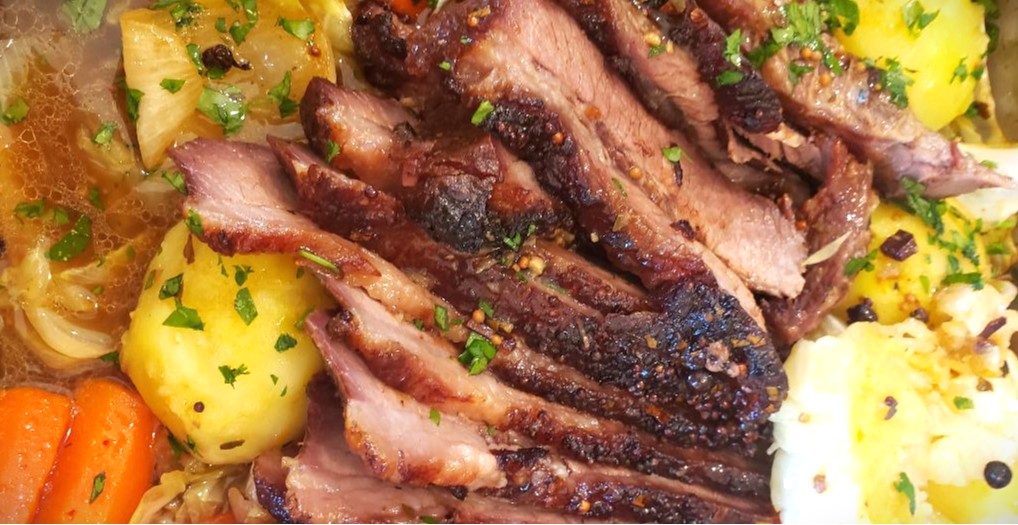
On the eve of St. Patrick’s Day, I went to the grocery store expecting to see some flacid, pink briskets floating in chemical water enhanced with papain. I had no expectation of finding anything resembling a naturally corned brisket. In the end, I just couldn’t buy the store-packaged blob. However, I did see a very nice flat-end brisket with a good-looking fat cap. Recalling that I had corned my own beef in the past, I scooped up the brisket with visions of corned beef and cabbage already dancing in my head.
Except I forgot that the last time I made this I brined it for seven days.
With approximately 30 hours until the celebratory meal, I decided to experiment. What happened was pretty great. The brine is savory and very corned-beef like, and the brisket is a cross between a beefy brisket and a traditionally corned brisket. Because this process was so quick, Mr. Artifact called it a drive-by corning.
WTH is corning anyway? Corning refers to corns of salt, not maize. It is regarded by some as a pickling process. Typically, the beef is put into a salty brine with spices for five days or even a month. Traditionally, it is then boiled or slow-cooked for several hours.
Ingredients
- 3 lb brisket (flat end or point end)
- 3-5 medium sized new potatoes (like red)—whole
- 3 very large carrots—peeled and cut into large chunks
- ½ to 1 yellow onion—large chunks
- ½ cabbage or enough for 6 cups of large chunks
- ½ cube butter
- Chopped parsley to garnish
- Quick rub (below)
Quick Rub (for a 3 lb brisket)—mix together for a dry rub
- 1 C maple sugar
- 1/3 C coarse sea salt
- 3 T juniper berries
- 1-2 cinnamon sticks (smashed with a hammer into shards) (about 2 T total)—do not use powder.
- 2 T yellow mustard seeds
- 1 T garlic powder
- 1 T onion powder
- 2 t whole allspice berries
- 4 bay leaves
- 2 t freshly ground black pepper
- 2 t coriander seeds
- 2 t red pepper flakes
- 1 t whole cloves
- ¼ t dried ginger
Method
- Coat brisket with all the rub.
- Put into a bag and rub/mound all the extra over the top and bottom. (Bonus if you can vacuum seal it.)
- Refrigerate for as long as you can, turning every 8-12 hours. I refrigerated mine for 24 hours and only turned it once. (Don’t worry, the dry ingredients will begin to liquify.)
Cooking
- Preheat oven to 350F.
- Move the brisket to an oven proof roasting bag and pour all the contents over the top, ensuring that the fat cap is on top. Close the bag (with the ovenproof little twisty ties that come with the bag) and place into a pan, then into a 350F oven. (You could use a lidded casserole if you prefer.)
- While the brisket is in the oven, pre-cook your potatoes and carrots in boiling water with a good dose of salt on the stove top until done. They should be tender enough to pierce with a knife. This may take anywhere from 10 to 20 minutes depending upon how large your potatoes and carrots are. Drain, lightly salt, add butter, cover, set aside OFF the heat. You can do this way ahead of time.
- Cook brisket at 350F for 1 hour. Then, decrease the heat to 325 F and cook for another 1 ½ hours (2 ½ total hours elapsed). Remove pan from oven, open up the bag and pour the juices and the brisket (fat cap up) into the cooking pan directly. Add the onions and cabbage. Stir to make sure veggies get all infused and entwined with the juice. Return pan to the oven. Cook for another 30 minutes (3 total hours elapsed time).
- After your total 3 hours, check to see if brisket is tender. It should be showing signs of beginning to shred at the edges. If it needs more time, put it back. Once it is done to your liking, take the brisket out of the pan and put it on a plate to rest for 10-15 minutes.
- Add the potatoes and carrots and butter back into the pan with the cabbage and onions and return it to the oven (without the resting brisket). Increase heat to 350F. Let this cook while your brisket rests for 10 or so minutes.
- Slice the brisket and place it back in the pan with the veggies.
- Garnish with parsley. It is now ready to serve.
What if you begin to run out of juice in the pan? You can add some stock or even a cup of water or beer.
Disclaimer: if your spices (allspice, cloves, juniper berries, etc) are small, they are certainly going to get infused and stuck to all your meat and veg. You might want to pick them out or warn your guests.
Stay briny,
–Stacey

 Butternutplace